Written by Ellen Birkett Morris
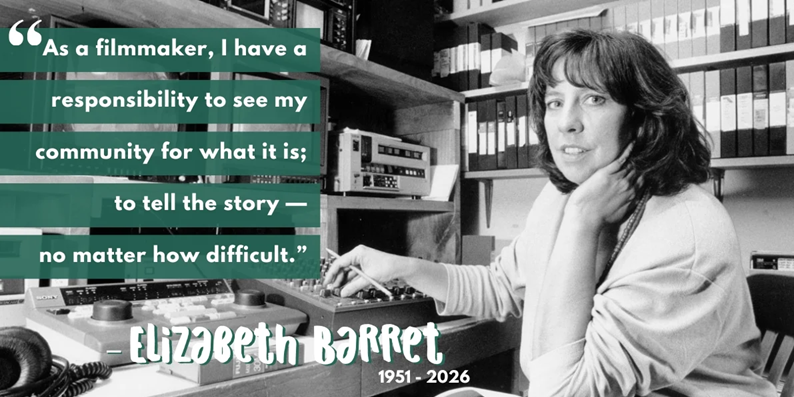
It’s hard to know who plays a bigger role, the chroniclers of our culture or those who work to preserve our history. Late filmmaker and Archivist Elizabeth Barret did both.
Barret produced some of Appalachia’s most acclaimed documentaries. Her first film, Nature’s Way, explored the culture and history of the people and the region. It highlighted the practice of folk medicine to cure using herbs, Native American folklore, and homegrown remedies. Her next film Quilting Women captured the traditional art of Appalachian quilting, featuring generations-old patterns and techniques, highlighting the patience, and social connection involved in quilting bees. Other films include Coalmining Women and Long Journey Home, about the Appalachian Diaspora, and the celebrated film Stranger with a Camera.
On February 3, 2026, Barret passed away after a long illness. A graduate of the University of Kentucky, she went to work at Appalshop, then known as the Appalachian Film Workshop one day after graduating from the University of Kentucky.
In a tribute released by Appalshop, her colleague and friend Mimi Pickering said, “Elizabeth was always a keen observer who was attuned to significant cultural, social, or economic shifts in the region.”
In a piece broadcast on WEKU, Pickering noted, “She was just really an amazing person, and a really kind person. She always was reaching out to help anyone in need, and the number of people who’ve written and talked about her as a role model, as a mentor, particularly as a woman filmmaker.”
Barret’s most notable work, Stranger With A Camera, was selected in 2000 for the Sundance Film Festival and nominated for the Grand Jury Prize. The film is based on a story in The New Yorker by Calvin Trillin. In it, Elizabeth carefully examines the tragic murder of Hugh O’Connor, who had come to Eastern Kentucky to film there as part of international interest in the region, thanks to the War on Poverty.
O’Connor and his crew were interviewing a family living in a rental house in Jeremiah. The house’s owner Hobart Ison opened fire on the crew, killing O’Connor. Barret, who grew up in Hazard, used personal remembrance, archival footage and contemporary interviews to examine the incident, and its larger implications of Appalachian identity, storytelling, and the outsider’s view.
Judi Jennings, former executive director of KFW, was a friend and co-producer on the film. “Elizabeth brought her full self, high expectations, and unwavering commitment to every project she worked on. She had a deeply held code of ethical filmmaking and a calm and collected presence in every situation. You could always depend on her, and she was a very good friend to have.”
Jennings said working with her on Stranger with a Camera held both huge challenges and life-shaping bonding experiences with her.
“We worked together on it for eight years from 1992 to 2000. She never wavered on finishing the film and getting it right. We received a National Endowment for the Humanities grant and worked with nationally known documentarians. They pointed out that the film would be strongest if Elizabeth would narrate the story on camera. She didn’t want to do it at first, but she did and it made the film the best it could be. I admired her so much for that because it wasn’t her style at all. She just knew it was the right thing to do for the film” said Jennings.
Dee Davis, the former Appalshop executive director who produced the film, called it “perhaps the definitive film on what it meant to grow up here when so many of the world’s lenses were focused on the region.
Journalist John W. Miller author of “When the Hillbilly Shot the Filmmaker: The Genius of Stranger With A Camera,” wrote “What makes Stranger with a Camera remarkable is that the filmmaker, Barret, is from near the scene of the crime in Kentucky. She tells the story while relentlessly questioning herself and viewers on the deeper questions surrounding this random act of violence: Who should tell the story of a poor community? If it’s an outsider, how should they tell it? What are every storyteller’s responsibilities? Barret herself had the experience of living in an area while seeing the “poverty pictures on TV”, movies like Appalachia: Rich Land, Poor People.”
Elevating the voices of residents of Appalachia was central to her work.
“She believed people should tell their own stories, in their own words, on their own terms. That belief lives at the heart of Appalshop’s Archive and in everything we continue to do,” said Tiffany Sturdivant, Executive Director of Appalshop. “Liz’s work is a constant reminder of why we do this work; to honor memory, protect community history, and uplift voices too often left unheard.”
Stranger With A Camera appeared on PBS’s P.O.V. program and screening at numerous festivals and conventions, such as the Guggenheim Museum in both New York and Bilbao, Spain; the Yerba Buena Center for the Arts in San Francisco; the Museum of Modern Art in New York, among others. In 2002, The American Historical Association presented the John E. O’Connor Award to Stranger with a Camera, recognizing the film’s outstanding interpretations of history.
Barret was the recipient of a Guggenheim Fellowship, the Rockefeller Foundation Film/Video/Multimedia Fellowship, the Kentucky Arts Council Fellowship in Media Arts, and the NEA Southeast Media Fellowship.
Stranger With A Camera is now available to watch for free on Appalshop’s YouTube page.
Barret was also the founding director of the Appalshop Archive, formally established in 2002 to preserve and make accessible the creative works and history of both Appalshop and the wider Appalachian region. Along with organizing, cataloging, and digitizing Appalshop-made media, she could often be found searching high and low for other collections that might need preserving, largely those still in the hands of community members who did not readily have access to archival equipment and best practices.
“Liz taught me what a community archive is – a model that emphasizes the ongoing dialogue and sharing between archives and the communities that we document and preserve,” stated Chad Hunter, the current Director of the Appalshop Archive, who worked alongside Elizabeth as she dreamed up this new venture. “I learned from her the deep value in listening, and that people’s stories often bring unexpected, exceptional meaning to what’s on the shelves in our vault.”
Her legacy will continue to inspire female filmmakers and echo throughout the region for years to come.
“She’ll be remembered as a talented filmmaker, committed Appalshop worker, champion of the archives, dedicated mother, and an exceedingly good friend,” said Jennings.
Material for this tribute came from personal interviews, Appalshop, WEKU and The Lexington Herald-Leader.