
“Only I Can Tell My Story”:
How Tina Parker Uses Poetry to Unearth Hidden Histories

Tina Parker
For more than twenty years, Tina Parker has been doing the work of excavation, looking closely at what gets passed down through families, through places, and through silence. A poet with roots in Appalachia, her writing returns to questions of memory, inheritance, and voice.
Over those years, Parker has received support from the Kentucky Foundation for Women (KFW) through grants, group retreats, and writing residencies at Hopscotch House and Loretto. Early Artist Enrichment grants supported the development of what became her full-length collections Mother May I and Lock Her Up, while more recent residencies at the Sisters of Loretto and funding from an Artist Career Development mini grant have provided ongoing time and space for her work. When she reflects on that support, she doesn’t frame it as a single breakthrough moment.
“It’s been foundational,” she says. “A foundation for me to further projects that I’ve dreamed up.”
Parker describes herself as a working poet, balancing writing with the demands of everyday life. Because of that, she relies on intentional space to create.
“My process requires time on retreat,” she explains. Those retreats have become central to her practice. They offer not just time to write, but also time to think, grieve, and sit with the materials that inform her poetry.
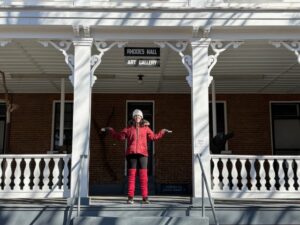
Tina in residency at Sisters of Loretto.
During a recent residency at Loretto, she worked closely with family documents—records that told stories of labor, illness, debt, and early death in the West Virginia coalfields. At Loretto, something opened for her.
“I made myself sit still… and just bawled my eyes out,” she says. After years spent caregiving for her father, that space and time at the residency allowed her to begin writing again.
Parker’s current manuscript draws from those same family archives, working with materials that are deeply personal: union cards, medical records, prison documents, and fragments of family life that had been tucked away for decades.
“I’m trying to figure out what I’ve inherited from this past family history,” she says.
The questions that emerge are not simple ones. What does it mean to come from a place that once held wealth and now holds poverty? What does it mean to work constantly and still struggle? How do systems like labor and incarceration shape entire generations and communities?
The project reflects a broader commitment in her work to tell stories that are often misunderstood or overlooked, asking readers to look more closely at the lives behind them.
“We cannot continue to dismiss entire groups of people based on their place or their work,” she says. “Writing… can open a little bit of a door.”
Much of Parker’s work centers on people whose stories have never been fully told, especially women. Her second full-length poetry collection, Lock Her Up, grew out of archival research into women who were institutionalized in the late 1800s and early 1900s.
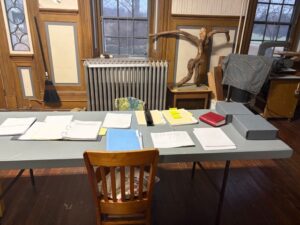
With support from a KFW Artist Enrichment grant, she traveled to the Library of Virginia and spent time accessing case files and records.
“I was able to look at women committed to the asylum… and spend time in those archives,” she says.
The book has resonated with readers in ways that continue to stay with her. After readings, people often share their own family histories—stories that were hinted at but never fully understood.
“If I can move just one person to say, ‘I want to tell my own story,’ then I’ve done something,” she says.
For Parker, writing has always been tied to claiming space.
“I grew up in a really male-dominated world,” she says. “I had to work hard to use my voice and to call myself a writer.”
She describes the ongoing work of pushing through the voices that say she shouldn’t write certain things or speak so directly. Writing becomes a way of refusing that pressure and creating room not just for herself, but for the women who came before her.
“That is really my ongoing act of feminism… Only I can tell my story…. I have a right to do this.”
Parker appreciates the relationships that have grown through KFW’s retreats and residencies, connecting her with other women artists.
“These are connections I wouldn’t have made otherwise,” she says.
She’s especially drawn to the structure of women-centered retreats—spaces that allow for both creative work and rest, where artists can show up as they are. One of her long-term goals is to create similar gatherings for women artists in her own community, where artists can come together, take time for their work, and support each other.
Over the years, Parker has returned to KFW support at different stages in her career as she has developed manuscripts, conducted research, and spent time in residency. That continuity has helped sustain her practice across multiple projects.
“KFW has given me the space to call myself a writer and a poet,” she says.
And through her work, those stories continue to reach others, opening the door for more voices.
To connect with Tina Parker, follow her on Instagram.
Click HERE to read some poems by Tina Parker at The Disappointed Housewife.
Buy Lock Her Up at Accents Publishing.
Buy Mother May I at Sibling Rivalry Press.
Click HERE to listen to an interview with Tina on WEKU.
Click HERE to listen to an interview with Tina on Rattle Poetry’s podcast.