KFW Congratulates 2026 Firestarter Award Winners
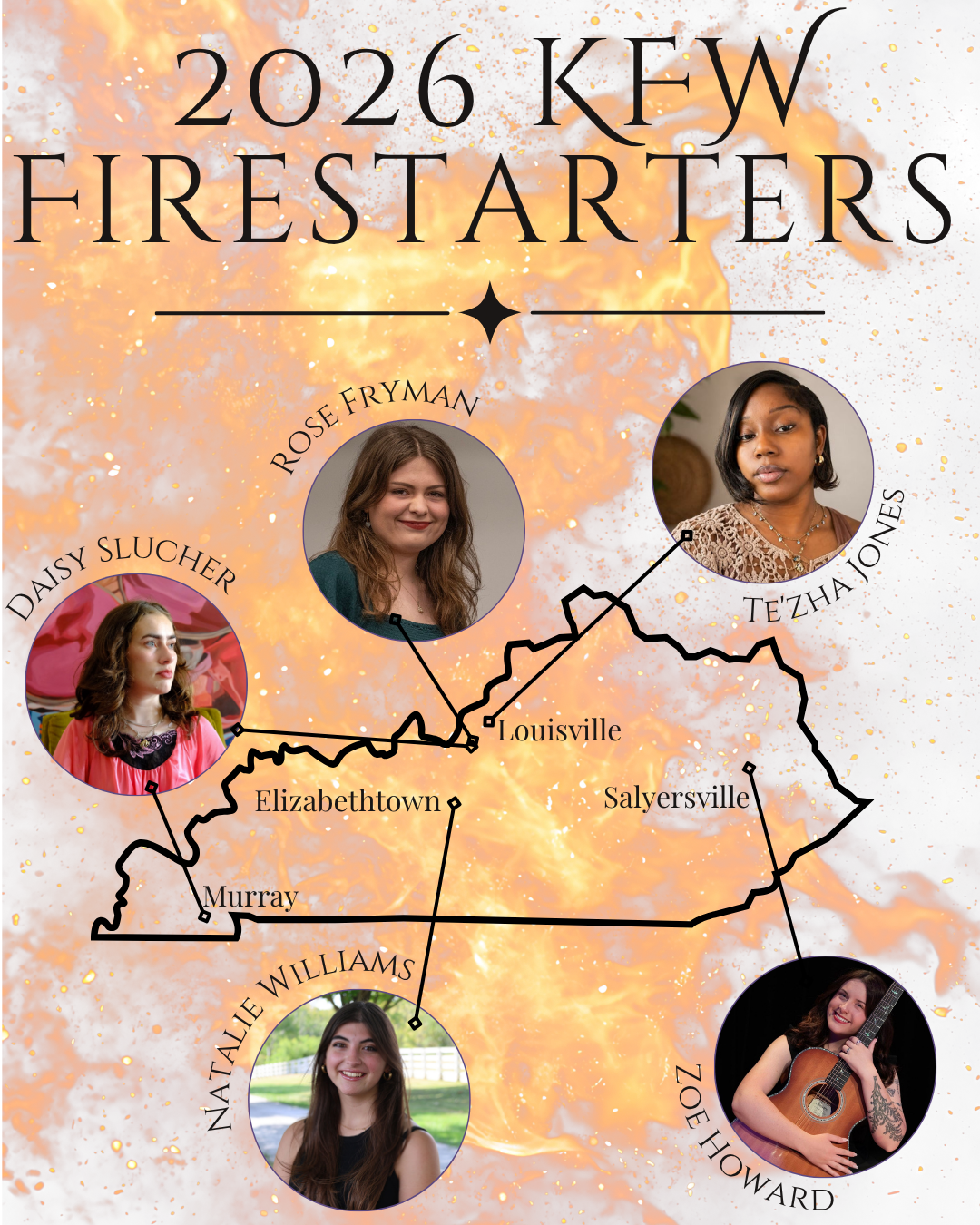
The Kentucky Foundation for Women is proud to announce that Zoe Howard, Te’zha Jones, Rose Fryman, Natalie Williams, and Daisy Slucher are the recipients of the 2026 Firestarter Award. The award will be given at the foundation’s annual celebration of community, KFW Day, on October 3.
The Firestarter award honors artists ages 18 to 26 who are taking risks in the creation of new art, involved in social justice/community engagement, and who demonstrate a developing feminist voice, including new insights and visions and/or fresh approaches to feminist topics or art for social change.
“These young feminist artists are creating work that calls us reexamine the lived experience of women in Kentucky through music, film, writing and art. They are illuminating issues of female representation, healing, reproductive justice, intergenerational abuse, and activism through art. Their work will blaze a path to a more just Kentucky and better world. They are awakening a new way forward with the vision that marks a true Firestarter,” said KFW Executive Director Sharon LaRue.
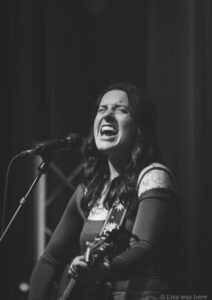
Zoe Howard
Zoe Howard, of Salyersville, is a songwriter, composer and performer who writes about the concerns and strengths of Appalachian women. Her songs and performances highlight the strength of Appalachian women. She teaches and mentors young female musicians. Zoe has released 3 full length EP’s and a single. She creates her own cover art. She has taken the stage at the Mountain Arts Center several times as well as other venues.
Howard says of her work, “I am a supporter of women and I am 100% for women in the arts. Most of the musicians in this area are men and festivals/venues only book men. I am against that. I am an Appalachian woman who loves all forms of art and I want my career, my life, and my morals to be of the arts. No matter what, support local, support women, and keep involved in the arts!
Te’zha Jones
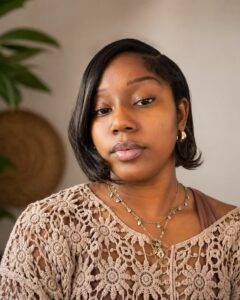
Te’zha Jones, of Louisville, is a multidisciplinary artist, filmmaker, and community organizer from Louisville, Kentucky. Her work lives at the intersection of storytelling, healing, and cultural organizing. Through film, writing, facilitated community gatherings, and social practice, she explores Black feminist healing, ancestral memory, reproductive justice, and our relationships to water, land, and the body. She is the founder of Wombs Unite, where she designs programs, facilitates conversations, and builds partnerships that center reproductive justice, wellness, and community care.
Jones says of her work, “I am currently creating The Water Knows It All, a short documentary that examines water as both a living relative and a keeper of memory. Alongside my filmmaking practice, I curate community movie circles through Wombs Unite, where film becomes a catalyst for dialogue, reflection, and collective care. I believe art is more than something we consume—it is a practice of remembering, connecting, and building the relationships necessary for collective liberation.”
Rose Fryman
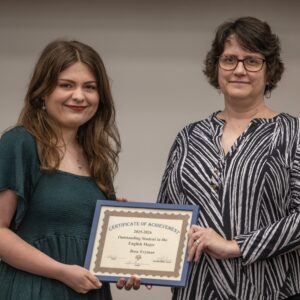
Rose Fryman, of Louisville, writes creative nonfiction and poetry that mostly explores the complexities of the female, Appalachian experience. She writes to examine important social and culture factors, including illustrating the cycle of intergenerational abuse through fragmented stories or displaying the intricate nature of female bonds through poetic imagery. She has worked with the Gateway Area Development District to provide resources and support to communities in Kentucky with the stories of those around her. Her fiction piece, “Within These Walls” was performed by the Appalachian Creatives Theatrical society (ACTS). Her Creative Nonfiction “Home Visit” won first prize and appeared in Inscape, Morehead State University’s literary journal.
Fryman says of her work, “I have always been drawn to exploring feminist perspectives in my writing, specifically through looking at motherhood, invisible labor, and domestic emotional abuse. My work questions cultural narratives of the traditional female role as well as female beauty standards that are rooted in the infantilization of women and aristocracy. I often try to use my writing to reflect the true beauty of womanhood that is much more complex and diverse than the image society consistently tries to push as the time’s current “ideal woman.”
Natalie Williams
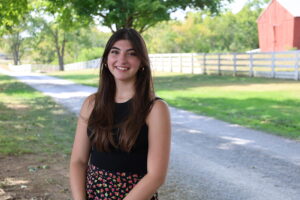
Natalie Williams, of Elizabethtown, performs and composes music inspired by LGBTQ and female Appalachian musicians, as well as songs related to her own experience with the Ford Blue Oval Battery Plant. Her most recent project is titled “’I Know What You’re Thinking When You Hear the Way I Talk’- The Appalachian Protest Music of Gunning, Ritchie, and Goodman.” In her work, she uses community archives from various counties in Appalachia to analyze the activism of women in social movements throughout the decades. She has highlighted suppressed voices and advocated for more queer protest music in Appalachia.
Williams says of her work, “I question norms in my research and music as I aim to recenter the focus of Appalachian activism and music from the stereotypical views of the region to the work of female and queer Appalachians to the forefront and highlighting how they facilitated social change. My work is heavily influenced by the voices of Kentucky women and LGBTQ artists, and I hope some of the rural experience is reflected in my work. I hope that it challenges stereotypes and preconceived notions regarding Kentucky and Appalachia, and that it encourages the listener and reader to see a different perspective. I am always seeking to continue researching and creating music and art.”
Daisy Slucher
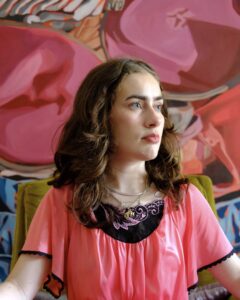
Daisy Slucher, of Louisville, is a painter whose work focuses on LGBTQ+ and Queer life in Kentucky, bodily autonomy, individuality, feminism, womanhood, gender and sexuality, and agency. Slucher earned her BFA from Murray State University in 2022 and has had her work featured across the region. Slucher attended the Kentucky Foundation for Women’s Artist Residency in Collaboration with the Loretto Motherhouse in September 2025, ahead of her debut solo show, “If a Tree Falls.” Her work has also been published in Fruitslice, a queer quarterly publication comprised of global contributors.
Slucher says of her work, “I make oil paintings about my experience as a queer woman who has only ever lived in Kentucky. The work is almost exclusively figurative, with the Kentucky landscape making its way into the work on occasion, and the highs and lows that come with living in a red state that you care about deeply. My work is inherently feminist. I started painting in response to the violence against women in Murray, Kentucky, in my own backyard.”